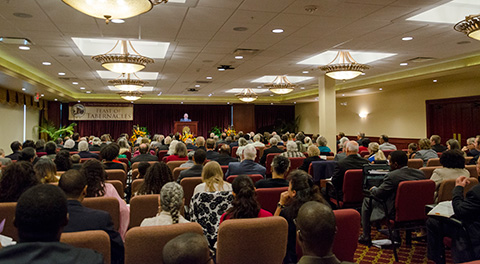
Sitting in silence at the Passover service, we watch as the minister breaks thin pieces of unleavened bread at the front of the room. Cracking and crunching are the only sounds heard as everyone in the congregation earnestly contemplates Jesus Christ’s body being broken—every joint out of place—as He was about to be hanged on the stake. The bread is passed around, and everyone takes a piece, silently reflecting on the forgiveness of our physical sins as we eat.
Shortly thereafter, the minister removes the covering from a silver tray of small glasses and asks for God’s blessing. The deep red wine in each cup has unmistakable symbolism—the blood Christ shed the day He died so we could be forgiven of our spiritual sins. As we drink it, we are stunned by what our Savior has done for us, yet joyous that we have been cleansed from sin. We feel immensely grateful for all God and Christ have done for us.
Yet before partaking of these symbols of bread and wine, we do something else—something no one would naturally associate with eating and drinking.
We wash each other’s feet.
Most forms of Christianity partake of the symbols of bread and wine during what they call communion services. While they take them improperly (some denominations do it weekly), these symbols of Christ’s death are at least recognized. Yet most completely ignore foot washing. There are glaring problems with this omission.
Notice Jesus’ clear instruction in John 13: “If I then, your Lord and Master, have washed your feet; you also ought to wash one another’s feet” (vs. 14).
If foot washing is done in the world, it is generally performed by church leaders, who only wash other people’s feet. But Christ’s instruction is plain and unmistakable for all Christians: “For I have given you an example, that you should do as I have done to you” (vs. 15).
Following Jesus Christ’s example and including foot washing at the Passover service is commanded and is one element of what brings us happiness (vs. 17). Despite feeling “out of place,” Jesus said that if we do not partake in the foot washing ceremony, “You have no part with Me” (vs. 8)—this is serious!
Foot washing is a necessary and crucial element of the New Testament Passover. How the world’s churches do not see this is hard to understand, but this is yet another way that God’s Church is set apart!
Even so, profound questions loom: Why is it important that we include foot washing in the Passover service? Of course, we wash one another’s feet because Jesus commanded us to. But to what purpose? And what does washing feet have to do with His death?
Christ’s Answer
Notice the question Jesus asked His disciples after washing their feet: “Know you what I have done to you?” (John 13:12). He wanted the disciples to understand the purpose of foot washing and how it integrates with the other elements of the evening in commemorating His death. He did not want them to just blindly observe it.
The answer lies in the verses quoted earlier from John 13. As the master over the other 12 disciples or “servants,” Christ lowered Himself to perform what would be considered a menial task done by servants and wants us to follow that example. He showed how even God in the flesh humbled Himself below others.
Herein lies a crucial lesson: The simple act of washing feet reminds us of the greatest example of lowering oneself—dying on the stake for our sins. Philippians 2:8 says it perfectly: “And being found in fashion as a man, He [Jesus] humbled Himself, and became obedient unto death, even the death of the cross.”
We should now better understand why foot washing is included in the Passover service. Christians today need not go to the extent Christ did by humbling ourselves to the point of crucifixion. But we must humble ourselves as a way of life, and foot washing is a tangible, practical way for Christians to follow Christ’s example.
The way He chose to teach this lesson of humility was in two parts: washing feet and having our own feet washed. Remember, John 13:14 says, “You also ought to wash one another’s feet.” This symbolic action shows us both how to serve and be served. Both require humility. These are crucial lessons that transcend Passover and can be applied every day of our lives.
Serving
Consider the physical act of washing another person’s feet. While the person is sitting in a chair, you must stoop down on your hands and knees on the floor below them, remove their shoes and socks (or sandals in Christ’s time), dip each foot in a basin and scrub the lowest parts of their body with your hands.
To wash another person’s feet is a true act of service. Those living God’s Way must serve others as a way of life—no exceptions. Jesus taught this throughout His ministry. In Matthew 23:11, He told the masses: “He that is greatest among you shall be your servant.”
Jesus Christ, who was the absolute greatest among men, lived a life of service toward others and taught His disciples to do the same.
Paul, after Christ’s death, said to the Romans, “I beseech you therefore, brethren, by the mercies of God, that you present your bodies a living sacrifice, holy, acceptable unto God, which is your reasonable service” (Rom. 12:1).
Our reasonable service is to give our bodies as living sacrifices to fulfill God’s will and Work. This is why Jesus Christ commanded us to humble ourselves to wash another person’s feet at the Passover—it teaches us to live lives of service!
Being Served
Washing someone’s feet feels a little strange, especially for us in modern times, when it is merely symbolic. Yet, for most of us, the more difficult, awkward and humbling part of foot washing is having our own feet washed. Why is that?
Consider Peter’s reaction when Jesus was about to wash his feet: “Then comes [Christ] to Simon Peter: and Peter said unto Him, Lord, do You wash my feet? Jesus answered and said unto him, What I do you know not now; but you shall know hereafter. Peter said unto Him, You shall never wash my feet. Jesus answered him, If I wash you not, you have no part with Me” (John 13:6-8).
This stopped Peter in his tracks. He began to understand the deep importance of having his feet washed, so he went to the other extreme, asking Jesus if He could wash not only his feet but his hands and head also (vs. 9).
We may initially feel like Peter did at the foot washing—unworthy to receive service. But service of any kind is a two-way street. For someone to be able to serve requires another to receive service. It can be humbling. It shows others that we are vulnerable and in need of help. But also consider that when we lower ourselves to receive service, we give the other person the blessing of serving us. They will be rewarded for helping us if we are willing to humble ourselves to receive it.
Way of Life
You now understand why foot washing—both the act of washing and being washed—are part of the Passover service. Foot washing is a simple example of how we can take on Jesus Christ’s mindset (Phil. 2:5) by practicing service as a way of life.
Thankfully, none of us have to lower ourselves in the same way Jesus did in death. But learning to humble ourselves in other ways teaches us to “fellowship [with] Christ’s sufferings,” as Paul said in Philippians 3:10.
As you examine yourself and study the Scriptures in preparation for Passover, take time to meditate on all the elements of the evening—including foot washing. Keep these vital lessons in mind as you participate in the service. Remember the deep spiritual meaning of this extraordinary evening and be ready to apply the lessons of serving and being served every day of your life.